
How to Predict Soccer Scores: A Step-by-Step Method
By Eren Şimşir · Published: · Updated:
Predicting a soccer score is harder than predicting a winner, because you must name two numbers instead of one. It is also more fun, and with a clear method you can make steadily better guesses than someone who just picks a favourite and adds a goal. This guide gives a process you can follow before you enter a pick on the prediction page.
Step 1: start from the base rate
Most top-flight leagues average a little under three goals per match, split roughly 1.5 for the home side and 1.2 for the visitors. That tells you where to begin: if you know nothing else, 1-1 and 2-1 are better opening guesses than 3-0. Every adjustment you make afterwards should move you away from this baseline for a reason you can state.
Step 2: judge the gap in quality
Ask how much better one team is than the other, using more than reputation. League position is a rough guide, but results are noisy. Better inputs include:
- Goal difference and expected goals difference over the season
- Rating systems such as Elo, which update after each result and account for opponent strength
- Squad depth, because a top side that rotates is weaker than its name suggests
A big quality gap should push the favourite’s expected goals up and the underdog’s down, but not as far as many fans expect. Even heavy favourites fail to score three in most matches.
Step 3: add home advantage
Playing at home is worth a measurable boost, usually a few tenths of a goal per game. It is smaller than it was a few decades ago, but it has not disappeared. Add it for both teams’ scoring estimates and, where a team has an unusually strong or weak home record, check that the gap is not just a small sample.
Step 4: check form and lineups
Only now look at recent matches, and look at them carefully:
- Results against comparable opponents, not just the scoreline.
- Chance creation rather than goals alone. See our explanation of expected goals.
- Confirmed or likely lineups. A missing first-choice goalkeeper or centre-forward changes a team’s expected goals more than a month of form does.
- Schedule. A team playing its third match in a week, or one with a bigger game in three days, often rotates.
Step 5: consider motivation and context
Knockout ties, relegation fights and final matchdays of a table-based competition change how teams play. The new Champions League format is a good example, because goal difference is the first tiebreaker. A side that needs a draw may sit deep. A side that has already qualified may field reserves. These effects are hard to measure, so keep them as a small tiebreak between close calls rather than a headline reason.
Step 6: choose a scoreline, not a story
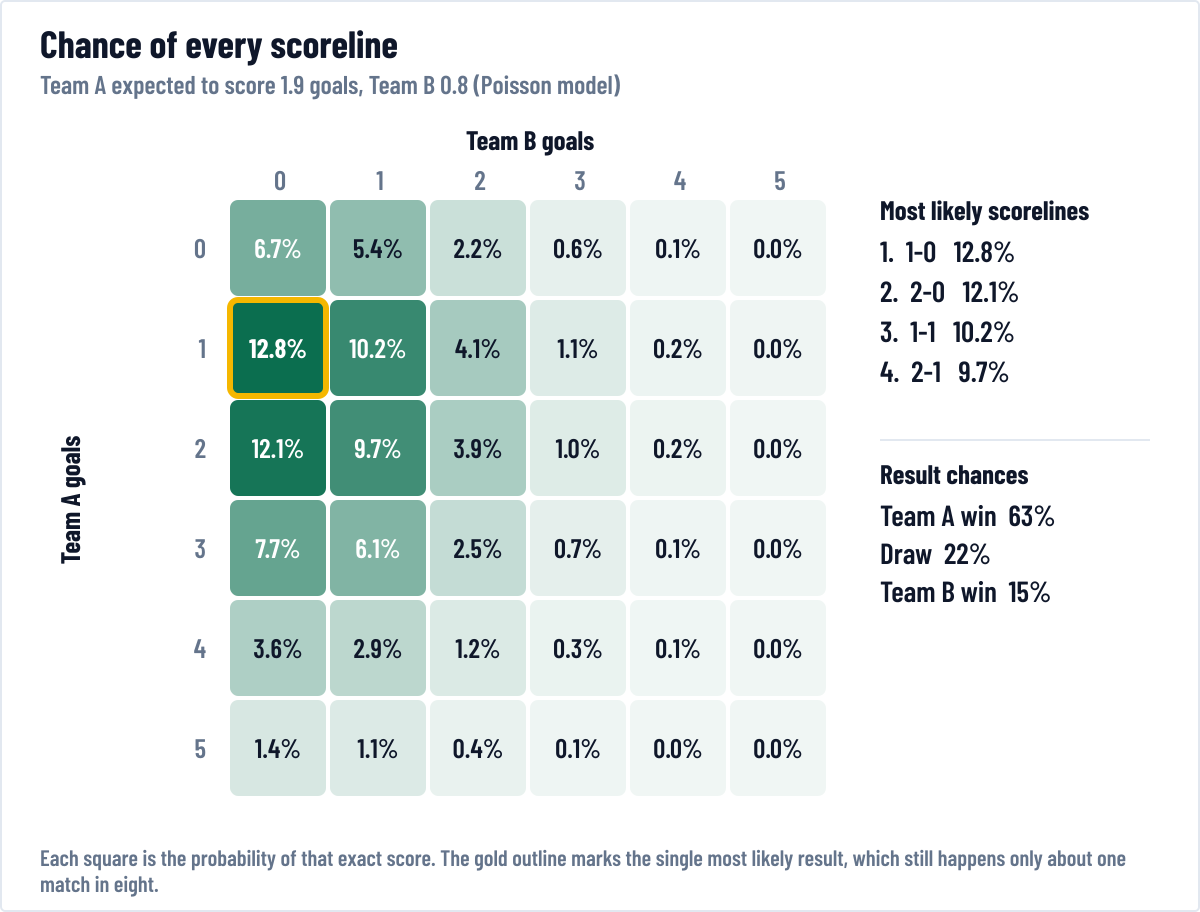
Here many predictions fail. A story (“they will crush them”) feels satisfying but ignores that the single most likely scoreline is usually modest. Suppose your analysis says Team A should score 1.9 goals and Team B 0.8. Rather than picking 3-0, check the probability of each scoreline: 2-0, 2-1 and 1-0 are each more likely than 3-0 would be. Choose the one with the highest probability, or the one that scores best under the game’s rules.
A worked example
Suppose the analysis gives Team A 1.9 expected goals and Team B 0.8. Running those two numbers through a Poisson model gives these chances:
| Scoreline | Probability |
|---|---|
| 1-0 to Team A | 12.8% |
| 2-0 to Team A | 12.1% |
| 1-1 | 10.2% |
| 2-1 to Team A | 9.7% |
| 3-0 to Team A | 7.7% |
Add them up and Team A wins about 63% of the time, the match is drawn about 22% of the time, and Team B wins about 15% of the time. The “crush” prediction of 3-0 is only the fifth most likely single scoreline. The most likely exact result, 1-0, still happens barely one time in eight. That is why exact-score games are hard, and why a clear method beats a confident story.
Step 7: match your pick to the scoring system
If a game gives 10 points for an exact score, 5 for the right result and goal difference, and 3 for the right result alone, as ours does, then consistency has value. Guessing the right winner earns something in most matches, while exact scores are rare. A sensible pick is often the likeliest result with a conservative margin.
Step 8: keep a record and learn
Write down every prediction, your reasoning and the result. After fifty matches look for patterns: are you overrating big teams, underrating draws or overreacting to the latest result? Honest feedback is the quickest way to improve.
Adjusting for league and competition
Scoring levels are not the same everywhere. Cup ties tend to be cagier than league games, and some competitions produce more goals because of weaker defences or open tactics. Before you apply the base rate in step one, check the average goals per match for that specific competition this season, and use the figure you find, not a general belief. A calibrated starting point is worth more than a sophisticated adjustment on top of a wrong baseline.
Common mistakes to avoid
- Recency bias. One 5-0 win does not make a team elite.
- Ignoring the draw. About a quarter of matches finish level.
- Overvaluing head-to-head history. Squads and managers change quickly.
- Chasing big scores. Predicting 4-2 will almost never be right, even when it feels plausible.
Soccer score predictions for leagues, cups and today’s fixtures
The method does not change with the competition. Whether you want soccer match score predictions for a Premier League weekend, a Champions League night or a World Cup group game, begin with that competition’s average goals, adjust for the gap in quality, add home advantage and then read the confirmed lineups. For a same-day soccer score forecast the lineups matter most, because they are usually published about an hour before kickoff and can move your view of a team more than a week of form.
Two habits help with tournaments. First, resist predicting a rout when a strong side meets a weak one: the likeliest scorelines are still 1-0, 2-0 and 2-1, as the grid above shows. Second, knockout ties are played more cautiously, so shade your pick towards the low-scoring end of the grid. Our own score predictor lists upcoming matches with the model’s scoreline and win probabilities, so you can check your pick against a consistent baseline before it locks.
How a model helps
A statistical model applies steps one to three consistently and without emotion, which is why we publish its output beside each match. You can then use steps four and five, the human context, to decide whether to follow the numbers or argue with them. We explain how our own model works on the methodology page.
Further reading
For league-by-league scoring averages you can verify yourself, FBref lists goals per match and expected goals for the major competitions.
Sources
- Dixon and Coles (1997), “Modelling association football scores and inefficiencies in the football betting market”, Journal of the Royal Statistical Society Series C. Method for turning team strengths into scoreline probabilities and the correction for low scores.
- Maher (1982), “Modelling association football scores”, Statistica Neerlandica. The independent Poisson model of football scores that the grid in this guide uses.
- Hvattum and Arntzen (2010), “Using ELO ratings for match result prediction in association football”, International Journal of Forecasting. Using rating gaps as the starting point for a forecast.
Frequently asked questions
What is the most common soccer score?
In most top leagues the most frequent scorelines are 1-1, 1-0 and 2-1 in some order. A low-scoring result is far more likely than most fans assume.
Should I predict draws?
Occasionally. Around one match in four ends level, but a draw is rarely the single most likely result, so predict one only when two evenly matched sides are expected to score little.
How many matches of form should I look at?
Five matches is a popular choice but a short sample. Blend recent form with season-long numbers rather than relying on the last five alone.
Is it better to predict a narrow win or a big win?
Usually a narrow one. Scorelines such as 1-0, 2-0 and 2-1 are individually more likely than 3-0 or 4-1, even when you expect the favourite to dominate.
Is there a free soccer score predictor?
Yes. Our free score predictor lists upcoming matches with the model's scoreline and win probabilities, and you can enter your own pick before kickoff. There is no betting and no payment.
How do I make soccer score predictions for the Premier League or the World Cup?
Use the same steps for any competition: start from its average goals, adjust for the gap in quality, add home advantage and check lineups. Even in tournaments, unequal sides are usually separated by one or two goals, so avoid predicting a rout.
Can anyone predict scores accurately every time?
No. Even the best models get the exact score right in a minority of matches, so judge a method over hundreds of predictions rather than a few.