
Home Advantage in Soccer: How Big Is It Really?
By Eren Şimşir · Published:
Every fan knows the feeling: a visiting team looks nervous in a loud stadium, a decision goes the hosts’ way, and the home side wins a game it was not expected to. Home advantage in soccer is one of the most consistent patterns in the sport, and it matters when you build a score prediction. Here is how large the effect is, what drives it and how to use it sensibly.
How big is it?
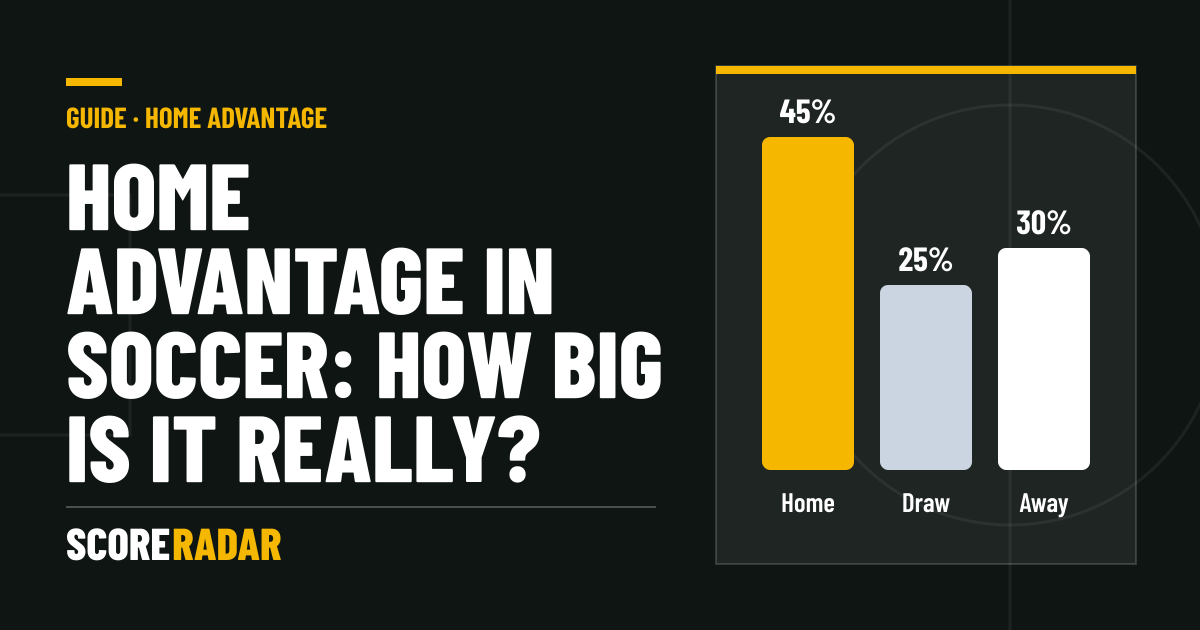
Across the major European leagues, home teams have historically won roughly 45% of matches, drawn about 25% and lost about 30%. Put in goals, hosts score around 0.3 to 0.5 goals more per match than they would on neutral ground, which is why the average home team scores about 1.5 and the average visitor about 1.2.
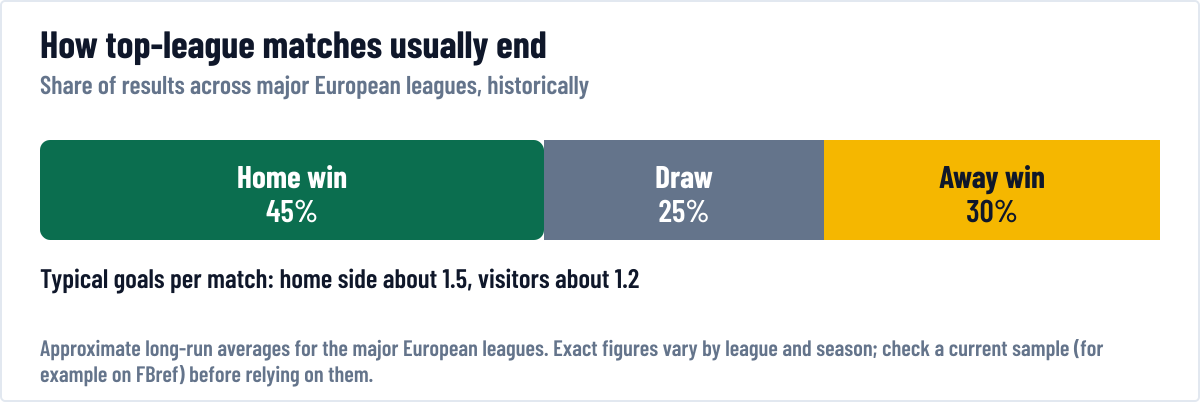
Two cautions apply. First, the size of the advantage has been slowly shrinking in many leagues over several decades, probably because of better travel, more uniform pitches and the use of video review. Second, the numbers differ from league to league and season to season, so check a recent sample for the competition you care about before assuming a fixed value.
Why does it exist?
Researchers have proposed several explanations, and most likely several operate together:
- Crowd and referees. Referees are human, and studies of decisions in front of loud crowds find a small bias toward the home side, particularly for close fouls and added time.
- Familiarity. Players know the size of the pitch, the surface and the sightlines.
- Travel and routine. Visitors lose time to journeys, unfamiliar hotels and disrupted preparation, though this matters less for short trips.
- Tactics and risk. Home teams tend to press higher and take more shots, while visitors often defend deeper.
- Psychology. Testosterone and confidence effects have been measured in home players, but their weight is debated.
What empty stadiums taught us
When top leagues resumed behind closed doors in 2020 and 2021, analysts got a rare natural experiment. In several leagues the home win rate and home goal advantage dropped, and the pattern of fouls and cards came closer to even. That points to the crowd as an important ingredient. It did not remove the advantage completely, so familiarity and tactics likely contribute as well.
It is not the same for every club
Some stadiums are more intimidating, some clubs travel across several time zones, and some teams play at altitude. A team’s own home record also depends on its quality: strong clubs win at home partly because they are strong everywhere. To avoid double counting, measure a club’s home form relative to its away form and league average, and be wary of conclusions drawn from fewer than ten home matches.
Myths worth dropping
“The home team always starts as the favourite.” Not when the visitors are much stronger. Home advantage is roughly worth the difference between a mid-table side and a slightly better one, not the difference between a relegation candidate and a champion.
“Away goals matter more.” The old away-goals rule in two-leg ties, which was scrapped in European competitions in 2021, gave visitors a tiebreak edge. It did not change the likelihood of scoring away from home.
“Late goals are more common at home.” Some fans believe the crowd drags the home team over the line in stoppage time. The evidence for a large late-goal effect is thin, so avoid building predictions on it.
Example: how the bonus changes a forecast
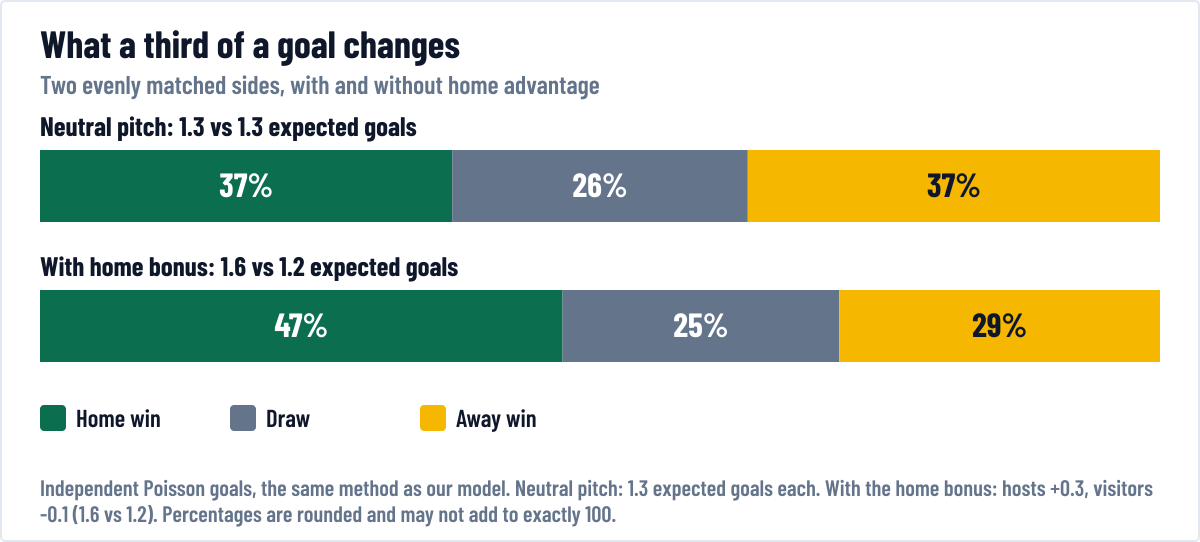
Take two evenly matched clubs. On a neutral pitch each would be expected to score about 1.3 goals, and the most likely result would be a 1-1 draw. Give the hosts an extra third of a goal and shave the visitors’ total by a tenth. The hosts now average about 1.6 and the visitors about 1.2. A home win becomes the single most likely outcome at about 47%, a draw stays near 25% and an away win falls to about 29%. The bonus did not make the home side a certainty. It moved the balance of probabilities by a few points each way, and that is the right way to think about it.
How to use it in predictions
- Start from the quality gap between the two teams, using a rating system such as Elo.
- Add a home bonus, equal to about a third of a goal in expected goals or about 65 to 100 rating points.
- Reduce the bonus for neutral venues, such as many cup finals, and consider an increase for clubs with an unusually strong record.
- Keep draws in mind: even with a home boost, the single most likely result between close teams is often a one-goal margin or a draw. See our Barcelona vs Aston Villa prediction for how this applies in upcoming European fixtures.
Data to check
For a current view, FBref shows home and away results, goals and expected goals for each major league so you can compute the home split yourself.
The bottom line
Home advantage is a modest but dependable edge, worth giving to the host each time but not worth overpaying for. Treat it as one adjustment among several, and let team quality, lineups and context decide the rest.
Sources
- Pollard (2006), “Worldwide regional variations in home advantage in association football”, Journal of Sports Sciences. Size and regional variation of home advantage across football leagues.
- Bryson, Dolton, Reade, Schreyer and Singleton (2021), “Causal effects of an absent crowd on performances and refereeing decisions during Covid-19”, Economics Letters. The change in home advantage and refereeing when matches were played without crowds.
- Sutter and Kocher (2004), “Favoritism of agents: the case of referees’ home bias”, Journal of Economic Psychology. Evidence of referee bias towards the home side in front of a crowd.
Frequently asked questions
How often do home teams win in soccer?
In most top European leagues home teams win somewhere around 43% to 47% of matches, draws make up about a quarter, and away teams win the rest. Exact figures vary by season.
Why do home teams win more often?
Studies point to a mix of crowd influence on referees, familiarity with the pitch, absence of travel fatigue, tactical choices and team psychology. No single cause explains it all.
Did home advantage disappear without fans?
It shrank noticeably in many leagues during the 2020-21 matches played behind closed doors, which supports the crowd effect, though it did not vanish entirely.
Should I always pick the home team in a prediction game?
No. Home advantage tilts the odds but a strong visitor still beats a weak host. Add it as an adjustment to team quality rather than as a rule.