
How the New Champions League Format Works (36 Teams)
By Eren Şimşir · Published: · Updated:
The new Champions League format is easy to summarise: forget the eight groups of four. Since the 2024-25 season the competition opens with a single league phase in which 36 clubs share one table. This guide explains how the draw works, what each finishing position is worth and how ties are separated, so you can read the standings (and our score predictor) with confidence.
Why UEFA scrapped the group stage
Groups produced predictable results and a lot of dead matches in the final rounds, when a team had already qualified or been eliminated.
A single table means a late-season result in Madrid can still change the fate of a club in Prague. It also puts more quality matches on the calendar, because strong clubs meet opponents from every pot instead of the same three rivals twice.
How the league phase is organised
The 36 clubs are split into four pots of nine according to their UEFA club coefficient. Each club is then drawn against two opponents from every pot: one at home and one away. That makes eight matches, with four at home and four away, spread over eight matchdays between September and January.
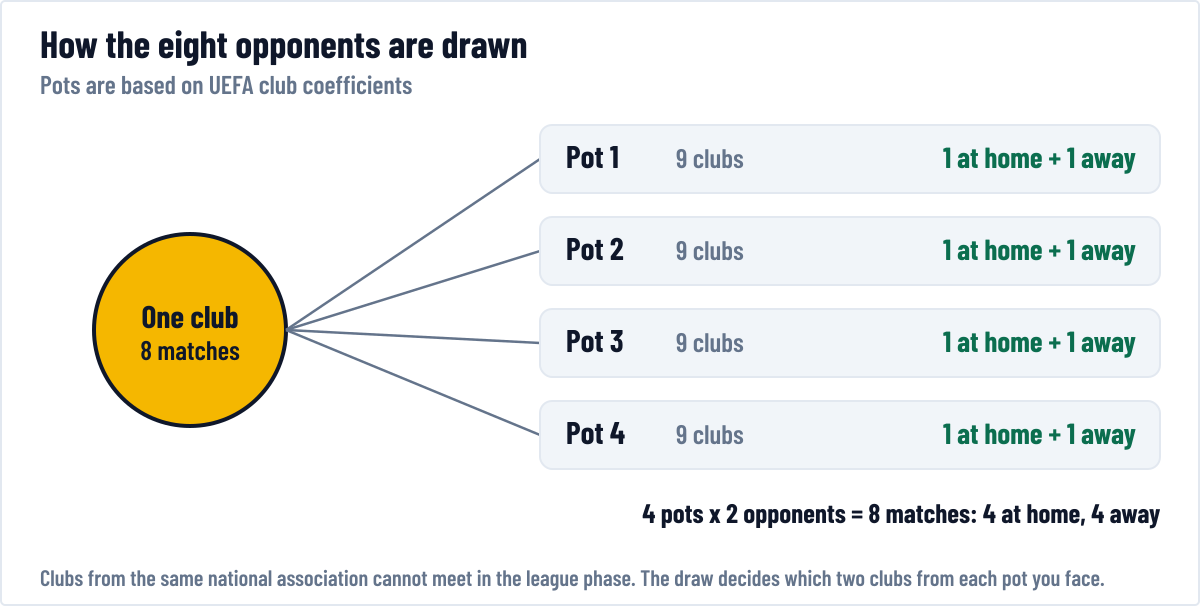
Two details matter when you predict results:
- Clubs from the same national association cannot meet in the league phase, and a club can face at most two opponents from one other association.
- Because every club has a different schedule, the table does not reflect strength of schedule until late in the competition. A team on 9 points after four games may simply have had the softer draw.
Matches are played in the usual midweek slots, with several kickoff times on each matchday, and the final round is staged simultaneously so no club can adjust its approach based on a rival’s result. That simultaneous finish is deliberate: with 36 clubs fighting over only eight direct places and sixteen play-off spots, the last night is where the table is decided.
What your final position means
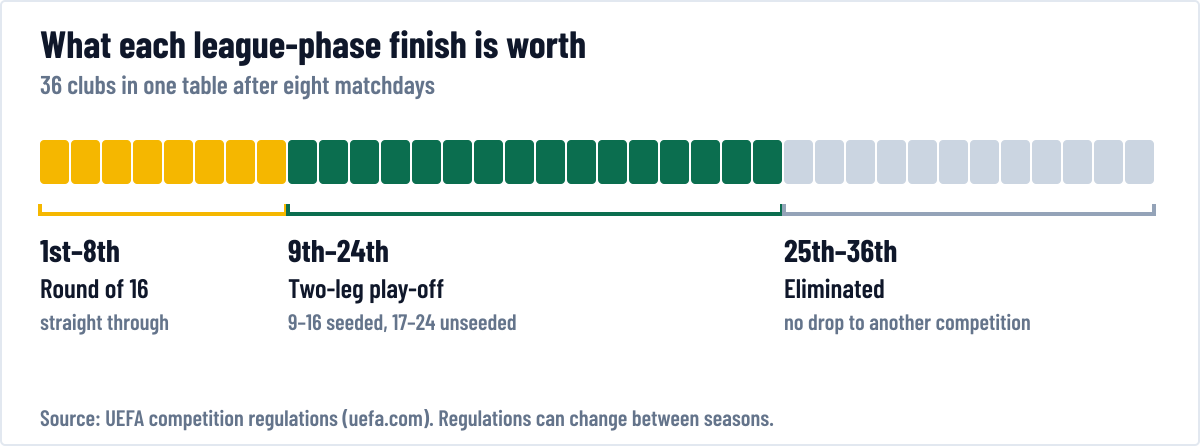
Points are the familiar 3 for a win, 1 for a draw and 0 for a defeat. After eight matchdays the table is split into three bands:
| Final position | What happens next |
|---|---|
| 1st-8th | Straight into the round of 16 |
| 9th-24th | Two-leg knockout play-off for the remaining eight places |
| 25th-36th | Eliminated from European competition |
The prize for the top eight is bigger than it looks. Those clubs skip two extra high-pressure matches in February, which matters in a season where the domestic calendar is already crowded.
How the play-offs work
The sixteen clubs ranked 9th to 24th are seeded: 9th-16th are seeded teams and 17th-24th are unseeded. Each seeded club is drawn against an unseeded one over two legs, and the seeded side plays the second leg at home. The eight winners join the top eight in the round of 16, and from there the tournament is a normal knockout bracket through to the final.
Finishing 9th rather than 17th is therefore worth a lot: you avoid the strongest unseeded opponents and you host the decisive leg.
How ties on points are broken
Several clubs usually finish level, so the order of tiebreakers is not a footnote. In sequence, UEFA looks at:
- Goal difference
- Goals scored
- Away goals scored
- Number of wins
- Number of away wins
- Combined points of all opponents faced
- Combined goal difference of all opponents faced
- Combined goals scored by all opponents faced
- Fair-play (disciplinary) record
- Club coefficient
Notice that goals scored matters before away goals, and that a club’s own record is checked before its opponents’ records. In practice most ties are settled by the first two criteria, which is why late-game goals are so valuable on the final matchday.
Common mistakes when reading the table
Fans new to the system tend to make the same errors, and they lead to bad predictions:
- Comparing clubs on different schedules. After matchday four, two clubs on seven points may have played completely different opponents. Look at who they have faced, not just the points.
- Assuming a fixed points target is safe. The points needed for the top eight differ from one season to the next. Check the final table of the last completed season on UEFA.com and treat any target as a rough guide rather than a rule.
- Ignoring goal difference until the last night. Because it is the first tiebreaker, a heavy win in October can be worth a place in the top eight in January.
- Forgetting the home leg. In the play-off the higher-ranked club hosts the second leg, which is the more valuable of the two ties to control.
What this means for score predictions
The format rewards teams that win big against weaker sides, because goal difference is the first tiebreaker. Our model estimates expected goals for both teams rather than just picking a winner, so you can see how likely a big margin is. When a side needs a margin of victory to climb into the top eight, treat the match as higher variance: a motivated favourite chasing goal difference can score late, while a team already safe may rotate.
You can try this yourself on the prediction page: enter an exact score and compare it with the model’s most likely scoreline and win probabilities. If you are curious who has scored the most goals in the competition itself, our list of Champions League top scorers sets out the all-time table and the records behind it.
Sources
- 2024-25 UEFA Champions League league phase, Wikipedia, Wikipedia. The 36-club league table, pots, eight matches per club and the play-off round.
- UEFA Champions League, Wikipedia, Wikipedia. History of the competition and the format change from the group stage.
- UEFA, Champions League pages, UEFA. The official source for the current regulations, which can change between seasons.
Frequently asked questions
How many teams are in the Champions League league phase?
There are 36 clubs in one combined table. The old eight-group, four-team stage was replaced by this league phase from the 2024-25 season.
How many matches does each club play in the league phase?
Eight. Every club meets two opponents from each of the four seeding pots, once at home and once away, so no club plays the same team twice.
Do teams that finish 25th to 36th drop into the Europa League?
No. Clubs finishing 25th or lower are eliminated from European competition for the season; there is no transfer to a second-tier tournament.
What decides the order when clubs finish level on points?
Goal difference comes first, then goals scored, away goals scored, wins and away wins, followed by opponents' combined record and finally disciplinary points and coefficient.